Today's
EarthStation1.com 15% Off Commemorative Memorial Title: Classic
Movie Trailers & Drive-In Movie Ads DVD, Download, USB Drive
Today, May 11, 2026
May 11: National Eat What You Want Day:
-- Drop your rules and restrictions around eating and just enjoy
life a little by eating what you want on this health and body
image conscious day! Restricting yourself from your favorite foods
can be difficult. That is why on this day people are encouraged to
treat themselves by giving in to their sweet tooth, carb-loading
without having a marathon to run, and eating breakfast for dinner.
Because on Eat What You Want Day, no one can tell you what NOT to
eat! Many people spend time stressing over their diet, and what
they should or shouldn't eat, mainly because today's world is
filled with magazine covers sporting perfectly toned, perfectly
tanned models that constantly make us feel inadequate. The various
health food fads that seem to come and go every few weeks
definitely don't help, either-as it turns out, a gluten-free diet
is not particularly good for anyone who isn't actually allergic to
gluten, juice cleanses deprive us of the protein and fat our
bodies need to function properly, and taking too many vitamin
supplements just makes our urine expensive when our bodies flush
the excess. If you, like many people these days, are beginning to
feel disillusioned with all of these things, you will be glad to
hear about National Eat What You Want Day. National Eat What You
Want Day was created by Thomas and Ruth Roy to help people break
away from the frustrating health and diet trends of our times, if
for only one day, and just let go and enjoy life a little. Most
nutritionists seem to agree that giving yourself a break every now
and again can actually be good for us, and that forcing ourselves
to eat only low-calorie, tasteless foods for prolonged periods of
time is likely to cause us to suddenly gorge on everything in
sight when our determination wears off. A lot of people have a
structured way of consuming food. Many have to be careful about
what they eat, otherwise, they will put on weight and their health
will suffer. Not everyone is blessed with a naturally fast
metabolism. However, National Eat What You Want Day gives you the
perfect opportunity to have the freedom to choose what you want
without feeling guilty about it. It is also perfect if there is
something that you have wanted to try for a while but you've been
holding out because you don't want to cheat your diet. On Sale @
15% Off Discount Till Midnight PT!
https://store.earthstation1.com/classic-movie-trailers-and-drivein-movie-ads-dvds-2-disc-se2.html
Today's
EarthStation1.com 15% Off Commemorative Memorial Title: TV
Commercials: The Classics Vol. 6 DVD, Video Download, USB Drive
Today, May 11, 2026
May 11: Hostess CupCake Day: --
Celebrated annually to commemorate the day the first Hostess
CupCake sold in 1919. Produced by the Taggart Baking Company,
Hostess CupCakes were originally known as Chocolate Cup Cakes.
Hostess CupCakes became so popular that in 1988 alone, 400 million
of these cupcakes were sold. The number skyrocketed to 600 million
in 2011. After several mergers and acquisitions, Hostess Cupcakes
are now produced by Hostess Brands and are still a fan favorite in
the cupcake world. Hostess CupCakes were sold for the first time
on May 10, 1919. The first commercially-produced cupcake, Hostess
CupCakes were produced by the Taggart Baking Company. They were
originally called Chocolate Cup Cake. At the onset, two Hostess
CupCakes were priced at five cents. The cupcakes had a variety of
toppings, including malted milk or vanilla icing. During the
1940s, an orange-flavored cupcake was added to the mix. However,
it was during the 1950s that Hostess CupCakes took on the distinct
identity that it still has today. D.R "Doc" Rice, an
employee at Hostess, was assigned the task of further developing
the cupcake. He came up with the idea of including white squiggles
on top of the cupcake to make it unique from other cupcake brands.
Utilizing a new machine that was used to make Twinkles, another
Hostess product, vanilla creme filling was also added to the
cupcake. This new and improved cupcake was first test-marketed in
the state of Detroit. By 1988, 400 million Hostess CupCakes were
sold in just one year. This number shot up to 600 million cupcakes
in 2011. In 1925, the Taggart Baking Company was bought by
Continental Baking, and later renamed Hostess CupCakes.
Unfortunately, the company declared bankruptcy in 2012 but
thankfully, was purchased by Apollo Global Management the
following year. Now called Hostess Brands, Hostess CupCakes are
still being produced and sold today, along with other Hostess
products like Ding Dongs, Coffee Cakes, Twinkies, Brownies,
Snoballs, Crispy Minis, Baby Bundts, and so on. It is marvelous to
know that one can eat something developed 103 years ago that
remains delicious. On Sale @ 15% Off Discount Till Midnight PT!
https://store.earthstation1.com/tv-commercials-the-classics-vol-6-dv6.html
Today's
EarthStation1.com 15% Off Commemorative Memorial Title: Super
Sense Animal Perception/Plant Adaptation TV Series DVD, MP4, USB
Today, May 11, 2026
May 11: World Migratory Bird Day: --
Every year, birds travel thousands of miles to find warmer
climates, food and nesting grounds - a sign of the changing
seasons. With at least 4,000 different species of birds that are
regularly on the move each year, it's fun to learn more about them
and celebrate on World Migratory Bird Day! World Migratory Day had
its beginnings in 1993 when visionaries from the Smithsonian
Migratory Bird Center came up with the idea. First founded under
the name International Migratory Bird Day, the program was
originally directed by the National Fish and Wildlife Foundation
along with the US Fish and Wildlife Service. By 2007, the
responsibility for the day moved to the not for profit
organization, Environment for the Americas. By 2018, the
organization joined with others, including the Convention on
Migratory Services and Agreement on the Conservation of
African-Eurasian Migratory Water Birds to collaborate for World
Migratory Bird Day. While the official day of celebration for
World Migratory Bird Day is on the second Saturday in May each
year, the organization recognizes that migratory birds stop in
various places along their journey. This means that the
celebration can be flexible, depending on the location. In
addition, Environment for the Americas encourages people to also
catch the migratory birds on their way south in the autumn,
celebrating another time on the second Saturday in October. Each
year, World Migratory Bird Day declares a different theme that
brings light to the various issues inherent in the pursuit of the
conservation of migratory birds. Past themes have included
"Water", "Sing, Fly, Soar - Like a Bird", and
"Birds Connect Our World". On Sale @ 15% Off Discount
Till Midnight PT!
https://store.earthstation1.com/super-sense--animal-perception-tv-series-dvd-mp4-download-usb-driv4.html
Today's
EarthStation1.com 15% Off Commemorative Memorial Title: The Good
Old Time TV Theme Song MP3 CD, Audio Download, USB Drive
Today, May 11, 2026
May 11: National Twilight Zone Day: -- A
day of observance that features mysterious twists and turns
highlighted with eerie background music and unexplainable
occurrences. The television show The Twilight Zone was created,
written, and narrated by Rod Serling. It premiered on October 1,
1959. The episodes were wildly popular, stretched the imagination,
and captivated viewers. The show aired from 1959-1964. Rod Serling
also created the show's spin-off called Night Gallery. Each
episode presented unique stories that led the viewer on a journey
into an unknown situation. The characters often revealed their
backstories through intense exchanges. Settings ranged from the
wild west to penthouse suites. And yet each story took place in
the 5th dimension, in The Twilight Zone. Are you a fan of the
show? You can observe this national day when you: Watch old
episodes of the show. What's your favorite episode of The Twilight
Zone? Enter The Twilight Zone and host a party to celebrate the
day. We offer these great party ideas to get you started; Make 5th
dimension pinwheels; Offer fortune cookies; Cook a valentine
steak; Stir up a nutty mix of fear and superstition; Mix up some
beverages - use light and shadow, love potions; While snacking,
play some trivia; Invite guests to dress up as characters from
their favorite episodes; Take some photos of your experience in
The Twilight Zone; And don't forget to use
#NationalTwilightZoneDay to post on social media. On Sale @ 15%
Off Discount Till Midnight PT!
https://store.earthstation1.com/tv-theme-song-mp3-cd-classic-old-time-televisio3.html
Today's
EarthStation1.com 15% Off Commemorative Memorial Title: The Secret
Of The Templars Series + Bonus Title MP4 Video Download DVD
Today, May 11, 2026
May 11, 1310: Religion: The History Of Religion: Abrahamic Religions: Christianity: The Catholic Church (The Roman Catholic Church): Military Orders: The Knights Templar (The Poor Fellow-Soldiers Of Christ And Of The Temple Of Solomon): Arrests, Charges And Dissolution Of The Knights Templar: -- In France, fifty-four members of the Knights Templar are burned at the stake as heretics. The Poor Fellow-Soldiers of Christ and of the Temple of Solomon (Latin: Pauperes commilitones Christi Templique Salomonici), also known as the Order of Solomon's Temple, the Knights Templar or simply as Templars, were a Catholic military order recognised in 1139 by papal bull Omne Datum Optimum of the Holy See. The order was founded in 1119 and active from about 1129 to 1312. The order, which was among the wealthiest and most powerful, became a favoured charity throughout Christendom and grew rapidly in membership and power. They were prominent in Christian finance. Templar knights, in their distinctive white mantles with a red cross, were among the most skilled fighting units of the Crusades. Non-combatant members of the order, who formed as much as 90% of the order's members, managed a large economic infrastructure throughout Christendom, developing innovative financial techniques that were an early form of banking, building its own network of some 1,200 commanderies and fortifications across Europe and the Holy Land (one third more than all the castles of the nation states of Europe combined), maintaining its own unique economy, educational system and culture, and arguably forming the world's first multinational corporation. The Templars were closely tied to the Crusades; when the Holy Land was lost, support for the order faded. Rumours about the Templars' secret initiation ceremony created distrust, and King Philip IV of France, deeply in debt to the order, took advantage of the situation to gain control over them. In 1307, he had many of the order's members in France arrested, tortured into giving false confessions, and burned at the stake. Pope Clement V disbanded the order in 1312 under pressure from King Philip. The abrupt reduction in power of a significant group in European society gave rise to speculation, legend, and legacy through the ages. On Sale @ 15% Off Discount Till Midnight PT! https://store.earthstation1.com/seofteseboti.html
Today's
EarthStation1.com 15% Off Commemorative Memorial Title:
Perspectives On Christopher Columbus DVD, Video Download, USB
Drive
Today, May 11, 2026
May 11, 1502: The Age Of Discovery (The
Age Of Exploration): The Voyages Of Christopher Columbus: The
Fourth Voyage Of Christopher Columbus: -- Christopher Columbus
departs Cadiz to begin his fourth and final voyage to the
Americas. Before leaving, Columbus wrote a letter to the Governors
of the Bank of Saint George, Genoa, dated at Seville, April 2,
1502. He wrote "Although my body is here my heart is always
near you." Columbus made his fourth voyage nominally to
search for the Strait of Malacca to the Indian Ocean. Accompanied
by his brother Bartolomeo and his 13-year-old son Fernando, he
left Cadiz with his flagship Santa Maria and the vessels Gallega,
Vizcaina, and Santiago de Palos. He sailed to Arzila on the
Moroccan coast to rescue Portuguese soldiers whom he had heard
were under siege by the Moors. On June 15, they landed at Carbet
on the island of Martinique (Martinica). A hurricane was brewing,
so he continued on, hoping to find shelter on Hispaniola. He
arrived at Santo Domingo on June 29, but was denied port, and the
new governor, Francisco de Bobadilla, who hated Columbus,
arrogantly refused to listen to his storm prediction. Instead,
while Columbus's ships sheltered at the mouth of the Rio Jaina,
the first Spanish treasure fleet sailed into the hurricane.
Columbus's ships survived with only minor damage, while 29 of the
30 ships in the governor's fleet were lost to a storm on July 1.
In addition to the ships, 500 lives, including that of the
governor, and an immense cargo of gold were lost at sea. After a
brief stop at Jamaica, Columbus sailed to Central America,
arriving at Guanaja (Isla de Pinos) in the Bay Islands off the
coast of Honduras on July 30. Here Bartolomeo found native
merchants and a large canoe, which was described as being "long
as a galley" and filled with cargo. On August 14, he landed
on the continental mainland at Puerto Castilla, near Trujillo,
Honduras. He spent two months exploring the coasts of Honduras,
Nicaragua, and Costa Rica, before arriving in Almirante Bay in
Panama on October 16. On December 5, 1502, Columbus and his crew
found themselves in a storm worse than any they had ever
experienced. For nine days they endured the storm; Columbus wrote
"Never did the sky look more terrible; for one whole day and
night it blazed like a furnace, and the lightning broke with such
violence that each time I wondered if it had carried off my spars
and sails; the flashes came with such fury and frightfulness that
we all thought that the ship would be blasted. All this time the
water never ceased to fall from the sky; I do not say it rained,
for it was like another deluge. The men were so worn out that they
longed for death to end their dreadful suffering." While in
Panama, Columbus learned from the Ngobe of gold and a strait to
another ocean, but was told by local leader Quibian not to go past
a certain point down the river. After much exploration, in January
1503, he established a garrison at the mouth of the Belen River.
On April 6, one of the ships became stranded in the river. At the
same time, the garrison was attacked by Quibian and the other
ships were damaged. Shipworms also damaged the ships in tropical
waters. Columbus left for Hispaniola on April 16 heading north. On
May 10 he sighted the Cayman Islands, naming them "Las
Tortugas" after the numerous sea turtles there. His ships
next sustained more damage in a storm off the coast of Cuba.
Unable to travel farther, on 25 June 1503 they were beached in St.
Ann's Bay, Jamaica. For one year Columbus and his men remained
stranded on Jamaica. A Spaniard, Diego Mendez, and some natives
paddled a canoe to get help from Hispaniola. The governor, Nicolas
de Ovando y Caceres, detested Columbus and obstructed all efforts
to rescue him and his men. In the meantime Columbus, in a
desperate effort to induce the natives to continue provisioning
him and his hungry men, won their favor by predicting a lunar
eclipse for February 29, 1504, using Abraham Zacuto's astronomical
charts. Help finally arrived, no thanks to the governor, on June
29, 1504, and Columbus and his men arrived in Sanlucar, Spain, on
November 7. On Sale @ 15% Off Discount Till Midnight PT!
https://store.earthstation1.com/perspectives-on-christopher-columbus-documentaries-amp-films-dvd.html
Today's
EarthStation1.com 15% Off Commemorative Memorial Title: The
American Adventure: TV History Series 1607-1876 DVD MP4 USB Drive
Today, May 11, 2026
May 11, 1647: Freedom Of Religion
(Religious Liberty): The Jewish Diaspora: History Of The Jews In
The United States: History Of The Jews In Colonial America: The
Jewish Arrival In New Amsterdam: History Of The Jews In New York:
Jews In New York City: -- Peter Stuyvesant arrives in New
Amsterdam to replace Willem Kieft as Director-General of New
Netherland, the Dutch colonial settlement in present-day New York
City. On December 27, 1657, The Flushing Remonstrance was signed
by a group of Dutch citizens who were affronted by the persecution
of Quakers and the religious policies of Peter Stuyvesant; none of
the signatories were Quakers. The Flushing Remonstrance
articulates for the first time in North American history that
freedom of religion is a fundamental right, and it is considered a
forerunner to the United States Constitution's own provision of
freedom of religion articulated in the Bill of Rights. The
Remonstrance ends with the words: "The law of love, peace and
liberty in the states extending to Jews, Turks and Egyptians, as
they are considered sonnes of Adam, which is the glory of the
outward state of Holland, soe love, peace and liberty, extending
to all in Christ Jesus, condemns hatred, war and bondage. And
because our Saviour sayeth it is impossible but that offences will
come, but woe unto him by whom they cometh, our desire is not to
offend one of his little ones, in whatsoever form, name or title
hee appears in, whether Presbyterian, Independent, Baptist or
Quaker, but shall be glad to see anything of God in any of them,
desiring to doe unto all men as we desire all men should doe unto
us, which is the true law both of Church and State; for our
Saviour sayeth this is the law and the prophets. Therefore if any
of these said persons come in love unto us, we cannot in
conscience lay violent hands upon them, but give them free egresse
and regresse unto our Town, and houses, as God shall persuade our
consciences, for we are bounde by the law of God and man to doe
good unto all men and evil to noe man. And this is according to
the patent and charter of our Towne, given unto us in the name of
the States General, which we are not willing to infringe, and
violate, but shall houlde to our patent and shall remaine, your
humble subjects, the inhabitants of Vlishing." The Flushing
Remonstrance was a petition to Peter Stuyvesant (Dutch: Pieter
Stuyvesant or Petrus Stuyvesant) (c. 1610 - August 1672), the last
Dutch Director-General of the colony of New Netherland from 1647
until it was ceded provisionally to the English in 1664 (after
which it was split into New York and New Jersey, with lesser
territory becoming parts of other colonies, and later, states), in
which some thirty residents of the small settlement of Vlissingen
(known at the time in English as Vlishing, since historically
known in English as Flushing), requested an exemption to his ban
on Quaker worship. Vlissingen (Flushing) was originally settled by
English people operating under a patent, issued by Governor Willem
Kieft in 1645, granting them the same state of religious freedom
existing in Holland, then the most tolerant of European countries.
Peter Stuyvesant was a major figure in the early history of New
York City; his name has been given to various landmarks and points
of interest throughout the city, especially the New York City
neighborhood of Bedford-Stuyvesant and Stuyvesant Town, as well as
Stuyvesant High School, etc.. Peter Stuyvesant's 1656 ordinance
against illegal religious meetings had formally banned the
practice of all religions outside of the Dutch Reformed Church,
the established church of the Netherlands, in the colony. His
often-derided decision flew against the approximately hundred-year
development of religious tolerance in the Netherlands. During this
time the country was revolting against Spanish rule, rebelling
against an imposed Inquisition, attempting to form a national
identity, and trying to unify Calvinist and Catholic provinces. At
the same time, Stuyvesant also opposed Jewish arrival in New
Amsterdam. On another front, the Stuyvesant family was broadly
tolerant. Judith, Stuyvesant's wife, was a fierce advocate for New
York's slaves, promoting the practice of baptism as a first step
toward freedom. His policy met with resistance from some English
settlers in the towns of Vlissingen (currently Flushing), Rustdorp
(currently Jamaica, Queens), and "'s Gravesande" (sic)
(currently Gravesend, Brooklyn), places where Quaker missions were
sent. Stuyvesant's actions, however, also met with the support of
other English settlers and magistrates who informed on those
embracing unorthodox teachings and meeting in small and
unsanctioned religious meetings of lay people called conventicles.
Thus, Stuyvesant found himself drawn into the religious debates
and bickering of the English community in the Atlantic colonies
and debates in England which culminated in the Conventicle Act
1664 that likewise banned religious assemblies. This policy
resulted in numerous acts of religious persecution and harassment.
In 1656 William Wickenden, a Baptist minister from Rhode Island,
was arrested by Dutch colonial authorities, jailed, fined, and
exiled for baptizing Christians in Flushing. In the same year
Robert Hodgson was arrested, tried, and sentenced to two years of
manual labor with slaves for his preaching of Quakerism. In 1661,
in the town of Rustdorp, Henry Townsend (Norwich) and Samuel
Spicer were fined for holding Quaker conventicles and Townsend was
banished as well. Stuyvesant sent three new magistrates, all
Englishmen, and a half dozen soldiers to gather information on
dissidents. The soldiers were billeted in the homes of the
dissidents until they agreed to conform. In 1662, in
's-Gravesande, Samuel Spicer and his mother, Micha, along with
John and Mary Tilton were imprisoned and later banished. They
moved to Oyster Bay, then outside of the authority of New
Netherland, and returned to their town after 1664 when the British
took control of the colony. In response to the Remonstrance,
Stuyvesant dismissed the local government and chose new Dutch
replacements as leaders. Four who signed were arrested by order of
Stuyvesant. Two immediately recanted, but the writer of the
remonstrance, Edward Hart, and sheriff of Flushing Tobias Feake
remained firm in their convictions. Both men were remanded to
prison where they survived in isolation on rations of bread and
water for over a month. After friends and family petitioned
Stuyvesant on behalf of the elderly Hart, the clerk was released
on penalty of banishment. Feake held out for a few more weeks, but
eventually recanted and was pardoned after being fined and banned
from holding public office. Stuyvesant asserted that he was not
violating the signers' "freedom of conscience," only
their right to worship outside of family prayer meetings. In
addition, he proclaimed March 13, 1658 a Day of Prayer for the
purpose of repenting from, incredibly, the sin of religious
tolerance. Subsequently, John Bowne of the colony allowed Quakers
to meet in his house. He was arrested in 1662 and brought before
Stuyvesant. Unrepentant, Bowne was sentenced to banishment to
Holland, though he was of English descent and spoke no Dutch.
After several months in the foreign land, Bowne petitioned the
directors of the Dutch West India Company. After a month of
deliberation, the Dutch West India Company agreed to support
Bowne, and advised Stuyvesant by a letter (1663) that he was to
end religious persecution in the colony. One year later, in 1664,
the colony fell to British control. The John Bowne House, built
before 1662, still stands in historic preservation. The Quaker
Meeting House in Flushing, built 1694, is now the oldest house of
worship in continuous use in New York State. The Quaker Meeting
House in Flushing, built in 1694 and located at 137-28 Norther
Boulevard (NY-25A) at the terminus of Linden Place, is now the
oldest house of worship in continuous use in New York State. On
Sale @ 15% Off Discount Till Midnight PT!
https://store.earthstation1.com/the-american-adventure-series-us-1st-century-4-dv14.html
Today's
EarthStation1.com 15% Off Commemorative Memorial Title: Portraits
Of American Presidents Nos. 1-42 TV Series MP4 Download DVD
Today, May 11, 2026
May 11, 1846: The Mexican-American War
(The Mexican War): Declarations Of War By The United States: The
United States Declaration Of War On Mexico: -- President James K.
Polk asks for and receives a Declaration of War against Mexico,
beginning the Mexican-American War, an armed conflict between the
United States of America and the United Mexican States (Mexico)
from 1846 to 1848. It followed in the wake of the 1845 American
annexation of the independent Republic of Texas, which Mexico
still considered its northeastern province and a part of its
territory after its de facto secession in the 1836 Texas
Revolution a decade earlier. In the decades preceding the war,
Native American raids in Mexico's sparsely settled north prompted
the Mexican government to sponsor migration from the United States
to the Mexican province of Texas to create a buffer. However, the
newly named "Texians" revolted against the Mexican
government of President/dictator Antonio Lopez de Santa Anna, who
had usurped the Mexican Constitution of 1824, in the subsequent
1836 Texas Revolution, creating a republic not recognized by
Mexico, which still claimed it as part of its national territory.
In 1845, the Texan Republic agreed to an offer of annexation by
the U.S. Congress and became the 28th state in the Union on
December 29 that year. In 1845, newly elected U.S. President James
K. Polk made a proposition to the Mexican government to purchase
the disputed lands between the Nueces River and the Rio Grande
river further south. When that offer was rejected, President Polk
moved U.S. troops commanded by Major General Zachary Taylor
further south into the disputed territory. Mexican forces attacked
an American Army outpost ("Thornton Affair") in the
occupied territory, killing 12 U.S. soldiers and capturing 52.
These same Mexican troops later laid siege to an American fort
along the Rio Grande. Polk cited this attack as an invasion of
U.S. territory and requested that the Congress declare war. U.S.
forces quickly occupied the capital town of Santa Fe de Nuevo
Mexico along the upper Rio Grande and the Pacific coast territory
province of Alta California (Upper California). They then invaded
to the south into parts of central Mexico (modern-day northeastern
Mexico and northwest Mexico). Meanwhile, the Pacific Squadron of
the United States Navy conducted a blockade and took control of
several garrisons on the Pacific coast farther south in lower Baja
California Territory. The U.S. Army, under the command of Major
General Winfield Scott, after several fierce battles of stiff
resistance from the Mexican Army outside of the capital, Mexico
City, eventually captured the city, having marched west from the
port of Veracruz, where the Americans staged their first
amphibious landing on the Gulf of Mexico coast. The 1848 Treaty of
Guadalupe Hidalgo, forced onto the remnant Mexican government,
ended the war and specified its major consequence, the Mexican
Cession of the northern territories of Alta California and Santa
Fe de Nuevo Mexico to the United States. The U.S. agreed to pay
15M USD compensation for the physical damage of the war. In
addition, the United States assumed 3.25M USD of debt already owed
earlier by the Mexican government to U.S. citizens. Mexico
acknowledged the loss of their province, later the Republic of
Texas (and now the State of Texas), and thereafter cited and
acknowledged the Rio Grande as its future northern national border
with the United States. Mexico had lost over one-third of its
original territory from its 1821 independence. The territorial
expansion of the United States toward the Pacific coast had been
the goal of Polk, the leader of the Democratic Party. At first,
the war was highly controversial in the United States, with the
Whig Party, anti-imperialists, and anti-slavery elements strongly
opposing. Critics in the United States pointed to the heavy
casualties suffered by U.S. forces compared to earlier American
wars, and the conflict's high monetary cost. The war intensified
the debate over slavery in the United States, contributing to
bitter debates that culminated in the American Civil War
(1861-1865). In Mexico, the war came in the middle of continued
domestic political turmoil, which increased into chaos during the
conflict. The military defeat and loss of territory was a
disastrous blow. For the indigenous peoples who had never accepted
Spanish or Mexican rule, the change in border meant conflicts with
a new outside power. On Sale @ 15% Off Discount Till Midnight PT!
https://store.earthstation1.com/portraits-of-american-presidents-nos-142-tv-series-mp4-download1424.html
Today's
EarthStation1.com 15% Off Commemorative Memorial Title: Ironclads:
Monitor Vs. Merrimac DVD, MP4 Video Dowload, USB Drive
Today, May 11, 2026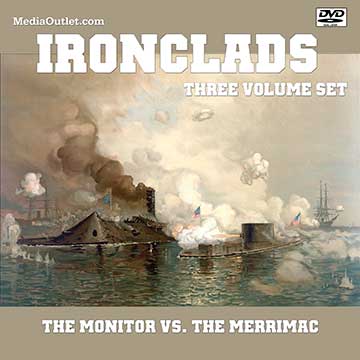
May 11, 1862: The American Civil War (The
Civil War, The War Between The States): Naval Warfare Of The
American Civil War: The Scuttling Of CSS Virginia (The Scuttling
Of The Merrimack): -- The Confederate Ironclad CSS Virginia is
scuttled in the James River by the Confederate Navy to prevent its
capture by Union forces advancing in Virginia. CSS Virginia was
the first steam-powered ironclad warship built by the Confederate
States Navy during the first year of the American Civil War; she
was constructed as a casemate ironclad using the raised and cut
down original lower hull and engines of the scuttled steam frigate
USS Merrimack. Virginia was one of the participants in the Battle
of Hampton Roads opposing the Union's USS Monitor in March 1862,
the most noted and arguably most important naval battle of the
American Civil War from the standpoint of the development of
navies, the battle ending without a clear victor. The battle is
chiefly significant in naval history as the first battle between
ironclads; naval warfare was thus changed forever, making wooden
ships obsolete. On Sale @ 15% Off Discount Till Midnight PT!
https://store.earthstation1.com/ironclads-monitor-vs-merrimac-dvd-us-civil-war-documentary.html
Today's
EarthStation1.com 15% Off Commemorative Memorial Title: Irving
Berlin: The Voice Of The City Plus Bonus Title MP4 Download DVD
Today, May 11, 2026
May 11, 1888: #BOTD: #HBD! Irving Berlin,
Belarusian-American pianist, composer and lyricist, widely
considered one of the greatest songwriters in American history (d.
September 22, 1989) is #born Israel Isidore Beilin in Tyumen,
Imperial Russia. His music forms a great part of the Great
American Songbook. Berlin arrived in the United States at the age
of five, and began singing in saloons and on street corners to
help his family following the death of his father. He published
his first song, "Marie from Sunny Italy", in 1907,
receiving 33 cents for the publishing rights, and had his first
major international hit, "Alexander's Ragtime Band" in
1911. He also was an owner of the Music Box Theatre on Broadway.
It is commonly believed that Berlin could not read or write
musical notation, and was such a limited piano player that he
could only play in the key of F-sharp using his custom piano
equipped with a transposing lever. "Alexander's Ragtime Band"
sparked an international dance craze in places as far away as
Berlin's native Russia, which also "flung itself into the
ragtime beat with an abandon bordering on mania." Over the
years he was known for writing music and lyrics in the American
vernacular: uncomplicated, simple and direct, with his stated aim
being to "reach the heart of the average American," whom
he saw as the "real soul of the country." In doing so,
said Walter Cronkite, at Berlin's 100th birthday tribute, he
"helped write the story of this country, capturing the best
of who we are and the dreams that shape our lives." He wrote
hundreds of songs, many becoming major hits, which made him famous
before he turned thirty. During his 60-year career he wrote an
estimated 1,500 songs, including the scores for 20 original
Broadway shows and 15 original Hollywood films, with his songs
nominated eight times for Academy Awards. Many songs became
popular themes and anthems, including "Alexander's Ragtime
Band", "Easter Parade", "Puttin' on the Ritz",
"Cheek to Cheek", "White Christmas", "Happy
Holiday", "Anything You Can Do (I Can Do Better)",
and "There's No Business Like Show Business". His
Broadway musical and 1943 film This is the Army, with Ronald
Reagan, had Kate Smith singing Berlin's "God Bless America"
which was first performed in 1938. Berlin's songs have reached the
top of the charts 25 times and have been extensively re-recorded
by numerous singers including The Andrews Sisters, Perry Como,
Eddie Fisher, Al Jolson, Fred Astaire, Ethel Merman, Louis
Armstrong, Frank Sinatra, Dean Martin, Elvis Presley, Judy
Garland, Barbra Streisand, Linda Ronstadt, Rosemary Clooney, Cher,
Diana Ross, Bing Crosby, Sarah Vaughan, Ruth Etting, Fanny Brice,
Marilyn Miller, Rudy Vallee, Nat King Cole, Billie Holiday, Doris
Day, Jerry Garcia, Willie Nelson, Bob Dylan, Leonard Cohen, Ella
Fitzgerald, Michael Buble, Lady Gaga, and Christina Aguilera.
Irving Berlin died in his sleep at his 17 Beekman Place town house
in Manhattan of a heart attack and other natural causes at the age
of 101. He is interred in the Woodlawn Cemetery in The Bronx, New
York City. Composer Douglas Moore sets Berlin apart from all other
contemporary songwriters, and includes him instead with Stephen
Foster, Walt Whitman, and Carl Sandburg, as a "great American
minstrel"-someone who has "caught and immortalized in
his songs what we say, what we think about, and what we believe."
Composer George Gershwin called him "the greatest songwriter
that has ever lived", and composer Jerome Kern concluded that
"Irving Berlin has no place in American music - he is
American music." On Sale @ 15% Off Discount Till Midnight PT!
https://store.earthstation1.com/irving-berlin-the-voice-of-the-city-dvd.html
Today's
EarthStation1.com 15% Off Commemorative Memorial Title: New York
City History Documentary Collection MP4 Video Download DVD
Today, May 11, 2026
May 11, 1894: #BOTD: #HBD! Martha Graham,
American modern dancer and choreographer whose style, the Graham
technique, reshaped American dance and is still taught worldwide
(d. April 1, 1991) is #born in Allegheny City (later to become
part of Pittsburgh), Pennsylvania. Graham danced and taught for
over seventy years. She was the first dancer to perform at the
White House, travel abroad as a cultural ambassador, and receive
the highest civilian award of the US: the Presidential Medal Of
Freedom with Distinction. In her lifetime she received honors
ranging from the Key to the City of Paris to Japan's Imperial
Order of the Precious Crown. She said, in the 1994 documentary The
Dancer Revealed: "I have spent all my life with dance and
being a dancer. It's permitting life to use you in a very intense
way. Sometimes it is not pleasant. Sometimes it is fearful. But
nevertheless it is inevitable." Founded in 1926 (the same
year as Graham's professional dance company), the Martha Graham
School is the oldest school of dance in the United States. First
located in a small studio within Carnegie Hall, the school
currently has two different studios in New York City. Martha
Graham died in New York City from pneumonia in 1991, aged 96,
having choreographed until her death. Just before she became sick
with pneumonia, she finished the final draft of her autobiography,
Blood Memory, which was published posthumously in the fall of
1991. She was cremated, and her ashes were spread over the Sangre
de Cristo Mountains in northern New Mexico. On Sale @ 15% Off
Discount Till Midnight PT!
https://store.earthstation1.com/new-york-city-history-videos-3-dvd-se3.html
Today's
EarthStation1.com 15% Off Commemorative Memorial Title: The
Fabulous Sixties with Peter Jennings TV Docuseries MP4 Or DVD Set
Today, May 11, 2026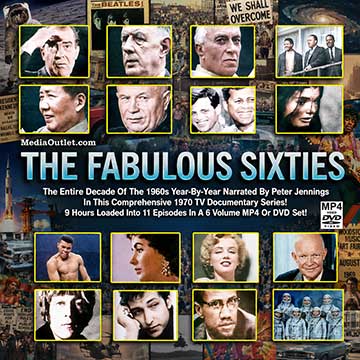
May 11, 1904: #BOTD: #HBD! Salvador Dali,
Spanish Surrealist painter, sculptor, photographer and performance
artist (d. January 23, 1989) is #born Salvador Domingo Felipe
Jacinto Dali i Domenech, Marquis of Dali de Pubol at 8:45 am, on
the first floor of Carrer Monturiol, 20 in the town of Figueres,
in the Emporda region, close to the French border in Catalonia,
Spain. Salvador Dali was a skilled draftsman, best known for the
striking and bizarre images in his work. His painterly skills are
often attributed to the influence of Renaissance masters. His
best-known work, The Persistence of Memory, was completed in
August 1931, and is one of the most recognisable Surrealist
paintings, whereas his 1954 painting Corpus Hypercubus remains one
of his most famous works of art. Dali's expansive artistic
repertoire included film, sculpture, and photography, at times in
collaboration with a range of artists in a variety of media. Dali
was highly imaginative, and also enjoyed indulging in unusual and
grandiose behavior. To the dismay of those who held his work in
high regard, and to the irritation of his critics, his eccentric
manner and attention-grabbing public actions sometimes drew more
attention than his artwork. Salvador Dali died in the town of his
birth, Figueres, Catalonia, Spain, in the morning of cardiac
arrest at the age of 84. He is buried in the crypt below the stage
of his Theatre-Museum in Figueres. The location is across the
street from the church of Sant Pere, where he had his baptism,
first communion, and funeral, and is only 450 metres (1,480 ft)
from the house where he was born. On Sale @ 15% Off Discount Till
Midnight PT!
https://store.earthstation1.com/decades-the-1960s-dvd-set-peter-jennings-tv-series-3-19603.html
Today's
EarthStation1.com 15% Off Commemorative Memorial Title: Hollywood
(1980) Silent Movie History Series DVD, Video Download, USB
Today, May 11, 2026
May 11, 1927: Film (Motion Pictures): The
History Of The Film Industry (The History Of The Motion Picture
Industry): Foundings: The Academy Of Motion Picture Arts And
Sciences (AMPAS, The Academy): -- The Academy Of Motion Picture
Arts And Sciences is founded, a professional honorary organization
with the stated goal of advancing the arts and sciences of motion
pictures. The Academy's corporate management and general policies
are overseen by a Board of Governors, which includes
representatives from each of the craft branches. The roster of the
Academy's approximately 11,000 (as of 2025) motion picture
professionals is a "closely guarded secret". While the
great majority of its members are based in the United States,
membership is open to qualified filmmakers around the world. The
Academy is known around the world for its annual Academy Awards,
now officially known as The "Oscars". In addition, the
Academy holds the Governors Awards annually for lifetime
achievement in film; presents Scientific and Technical Awards
annually; gives Student Academy Awards annually to filmmakers at
the undergraduate and graduate level; awards up to five Nicholl
Fellowships in Screenwriting annually; and operates the Margaret
Herrick Library (at the Fairbanks Center for Motion Picture Study)
in Beverly Hills, California, and the Pickford Center for Motion
Picture Study in Hollywood, Los Angeles. The Academy opened The
Academy Museum Of Motion Pictures in Los Angeles in 2021.
#AcademyOfMotionPictureArtsAndSciences #AMPAS #TheAcademy #Movies
#Film #MotionPictures #Cinema #Hollywood #ClassicalHollywoodCinema
#ClassicalHollywoodNarrative #ClassicHollywoodCinema
#GoldenAgeOfHollywood #OldHollywood #SilverScreen #Awards #Oscars
#AcademyAwards #MP4 #VideoDownload #DVD On Sale @ 15% Off Discount
Till Midnight PT!
https://store.earthstation1.com/hollywood-1980-tv-documentary-series-13-shows-4-dual-lay1980134.html
Today's
EarthStation1.com 15% Off Commemorative Memorial Title: Mort Sahl
Comedy Album MP3 MegaSet CD, Audio Download, USB Flash Drive
Today, May 11, 2026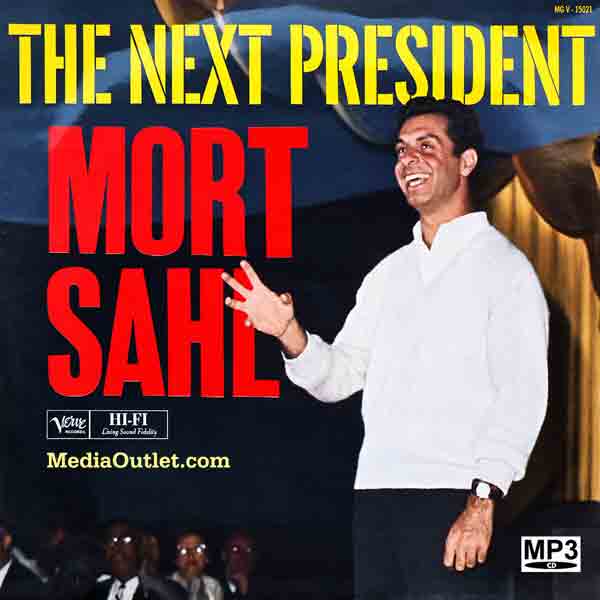
May 11, 1927: #BOTD: #HBD! Mort Sahl,
American comedian, actor, and social satirist, considered the
first modern stand-up comedian since Will Rogers (d. October 26,
2021) is #born Morton Lyon Sahl Mort Sahl in Montreal, Quebec,
Canada, the only child of Jewish parents. Mort Sahl pioneered a
style of social satire which pokes fun at political and current
event topics using improvised monologues and only a newspaper as a
prop. Sahl spent his early years in Los Angeles and moved to the
San Francisco Bay Area where he made his professional stage debut
at the hungry i nightclub in 1953. His popularity grew quickly,
and after a year at the club he traveled the country doing shows
at established nightclubs, theaters and college campuses. In 1960
he became the first comedian to have a cover story written about
him by Time magazine. He appeared on various television shows,
played a number of film roles, and performed a one-man show on
Broadway. Television host Steve Allen claimed that Sahl was "the
only real political philosopher we have in modern comedy."
His social satire performances broke new ground in live
entertainment, as a stand-up comic talking about the real world of
politics at that time was considered "revolutionary." It
inspired many later comics to become stage comedians, including
Lenny Bruce, Jonathan Winters, George Carlin and Woody Allen.
Allen credits Sahl's new style of humor with "opening up
vistas for people like me." Numerous politicians became his
fans, with John F. Kennedy asking him to write his jokes for
campaign speeches. After Kennedy's assassination in 1963, however,
Sahl became obsessed with the Warren Report's inaccuracies and
conclusions, and spoke about it often during his shows. This
alienated much of his audience and led to a decline in his
popularity for the remainder of the 1960s. By the 1970s, however,
his shows and popularity staged a partial comeback which continues
to the present. A biography of Sahl, Last Man Standing, by James
Curtis, was released in 2017. Mort Sahl died of natural causes at
his home in Mill Valley at age 94. He is buried at Hillside
Memorial Park in Culver City, Los Angeles County, California. On
Sale @ 15% Off Discount Till Midnight PT!
https://store.earthstation1.com/mort-sahl-comedy-album-mp3-megaset-cd-mp3-download-usb-flash-dri33.html
Today's
EarthStation1.com 15% Off Commemorative Memorial Title: TV Music &
Dance Shows #11 Shindig UK, Happening DVD, MP4, Flash Drive
Today, May 11, 2026
May 11, 1941: #BOTD: #HBD! Eric Burdon,
English singer, songwriter and actor, vocalist of rock band The
Animals and funk band War, regarded as one of the British
Invasion's most distinguished singers with his deep, powerful
blues-rock voice, known for his aggressive stage performances,
ranked 57th in Rolling Stone's list The 100 Greatest Singers of
All Time in 2008, referred to in The Beatles song "I Am The
Walrus" as "The Eggman", is #born Eric Victor
Burdon in Walker, Newcastle upon Tyne, England; his middle name
"Victor" had been chosen after encouragement from the
Lord Mayor, who offered new mothers 25 PS if their new-borns were
given a patriotic "war name." The Animals are an English
rhythm and blues and rock band, formed in Newcastle upon Tyne in
the early 1960s. The band moved to London upon finding fame in
1964. The Animals were known for their gritty, bluesy sound and
deep-voiced frontman Eric Burdon, as exemplified by their
signature song and transatlantic No. 1 hit single, "House of
the Rising Sun", as well as by hits such as "We Gotta
Get Out of This Place", "It's My Life", "Inside
Looking Out", "I'm Crying" and "Don't Let Me
Be Misunderstood". The band balanced tough, rock-edged pop
singles against rhythm and blues-orientated album material and
were part of the British Invasion of the US. The Animals underwent
numerous personnel changes in the mid-1960s and suffered from poor
business management. Under the name Eric Burdon and the Animals,
the much-changed act moved to California and achieved commercial
success as a psychedelic and hard rock band with hits like "San
Franciscan Nights", "When I Was Young" and "Sky
Pilot", before disbanding at the end of the decade.
Altogether, the group had ten Top Twenty hits in both the UK
Singles Chart and the US Billboard Hot 100. The original lineup of
Burdon, Alan Price, Chas Chandler, Hilton Valentine and John Steel
reunited for a one-off benefit concert in Newcastle in 1968. They
later had brief comebacks in 1975 and 1983. There have been
several partial regroupings of the original era members since then
under various names. The Animals were inducted into the Rock and
Roll Hall of Fame in 1994. War (originally called Eric Burdon and
War) is an American funk band from Long Beach, California, known
for several hit songs (including "Spill the Wine", "The
World Is a Ghetto", "The Cisco Kid", "Why
Can't We Be Friends?", "Low Rider", and "Summer").
Formed in 1969, War is a musical crossover band that fuses
elements of rock, funk, jazz, Latin, rhythm and blues, and reggae.
Their album The World Is a Ghetto was Billboard's best-selling
album of 1973. The band transcended racial and cultural barriers
with a multi-ethnic line-up. War was subject to many line-up
changes over the course of its existence, leaving member Leroy
"Lonnie" Jordan as the only original member in the
current line-up; four other members created a new group called the
Lowrider Band. Burdon and fellow rocker and guitarist, American
Jimi Hendrix, became very close friends in the mid sixties and
remained so up until Hendrix's death in 1970; Burdon was the
person Hendrix's girlfriend called when she found him overdosed on
drugs. Burdon was also a good friend of John Lennon and, claims
Burdon, was mentioned in one of their songs, "I Am the
Walrus" as "the eggman." Burdon states, "The
nickname stuck after a wild experience I'd had at the time with a
Jamaican girlfriend called Sylvia. I was up early one morning
cooking breakfast, naked except for my socks, and she slid up
beside me and slipped an amyl nitrite capsule under my nose. As
the fumes set my brain alight and I slid to the kitchen floor, she
reached to the counter and grabbed an egg, which she cracked into
the pit of my belly. The white and yellow of the egg ran down my
naked front and Sylvia began to show me one Jamaican trick after
another. I shared the story with John at a party at a Mayfair flat
one night with a handful of others." According to Burdon,
Lennon, finding the story hilarious, replied, "Go on, go get
it, Eggman," incorporating the incident into his song in
tribute to the unique experience. On Sale @ 15% Off Discount Till
Midnight PT!
https://store.earthstation1.com/classic-tv-music-amp-dance-shows-11-shindig-uk-amp-happening-d11.html
Today's
EarthStation1.com 15% Off Commemorative Memorial Title: Alaska At
War: Japanese WWII Invasion Of Alaska DVD, Download, USB
Today, May 11, 2026
May 11, 1943: World War II: The Pacific
War (The Asia-Pacific War, The Pacific Theater Of World War II):
The Pacific Ocean Theater Of World War II: The American Theater Of
World War II (The Americas Theater Of World War II): The Aleutian
Islands Campaign (The Alaksa Campaign) (Japanese: Aryushan Homen
No Tatakai, "The Battle Of The Aleutians"): The Battle
Of Attu (Operation Landcrab): -- American troops invade Attu
Island in the Aleutian Islands in an attempt to expel occupying
Japanese forces. The Battle of Attu, which took place on May
11-30, 1943, was a battle fought between forces of the United
States, aided by Canadian reconnaissance and fighter-bomber
support, and the Empire Of Japan on Attu Island off the coast of
the Territory of Alaska as part of the Aleutian Islands Campaign.
A battle of the Pacific War, it was one of the few military
actions that took place during the Second World War in the
American Theater, and was the only land battle of World War II
fought on incorporated territory of the United States. It is also
the only land battle in which Japanese and American forces fought
in Arctic conditions. The more than two-week battle ended when
most of the Japanese defenders were killed in brutal hand-to-hand
combat after a final banzai charge broke through American lines.
On Sale @ 15% Off Discount Till Midnight PT!
https://store.earthstation1.com/alaska-at-war-dvd-wwii-invasion-by-japan.html
Today's
EarthStation1.com 15% Off Commemorative Memorial Title:
Thunderbolt 1944 P-47 James Stewart + Reagan Zero Fighter DVD MP4
USB
Today, May 11, 2026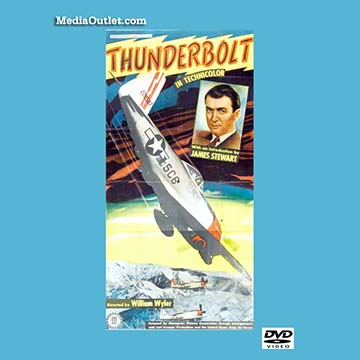
May 11, 1944: The European Civil War:
World War II: The Second European War (The European Theater Of
World War II): The Mediterranean And Middle East Theater Of World
War II: The Italian Campaign Of World War II (The Liberation Of
Italy): The Battle Of Monte Cassino (The Battle For Rome):
Operation Diadem (The Fourth Battle Of Monte Cassino, The Battle
Of The Liri Valley): Operation Strangle (World War II): -- The
Allies begin a major offensive against the Axis powers on the
Gustav Line. Operation Diadem, also referred to as the Fourth
Battle of Monte Cassino or, in Canada, the Battle of the Liri
Valley, was an offensive operation undertaken by the Allies of
World War II (U.S. Fifth Army and British Eighth Army in May 1944,
as part of the Italian Campaign of World War II. Diadem was
supported by air attacks called Operation Strangle. the subject of
the William Wyler's film "Thunderbolt" about the
fighter-bomber groups engaged in the operation. The opposing force
was the German 10th Army. The object of Diadem was to break the
German defenses on the Gustav Line (the western half of the Winter
Line) and open up the Liri Valley, the main route to Rome. General
Sir Harold Alexander, Commander-in-Chief (C-in-C) of the Allied
Armies in Italy (AAI), planned Diadem to coordinate roughly with
the invasion of Normandy, so that German forces would be tied down
in Italy, and could not be redeployed to France. Four corps were
employed in the attack. From right to left these were Polish II
Corps and British XIII Corps, of Eighth Army, and the Free French
Corps (including Moroccan Goumiers) and U.S. II Corps, of Fifth
Army. Fifth Army also controlled U.S. VI Corps in the Anzio
beachhead, some 60 miles northwest. Diadem was launched at 23:00pm
on 11 May 1944 by elements, composed of the British 4th Infantry
Division and 8th Indian Infantry Division with supporting fire
from the 1st Canadian Armoured Brigade. They made a successful
strongly opposed night crossing of the Garigliano and Rapido
rivers. This broke into the heart of the German defenses in the
Liri valley against strong opposition and drew German theater
reserves reducing pressure on the Anzio beachhead. The Free French
Corps pushed through the mountains to the left on 14 May,
supported by U.S. II Corps along the coast. On 17 May, Polish II
Corps on the right attacked Monte Cassino. The German position
collapsed, and the Germans fell back from the Gustav Line to the
Hitler Line some 10 miles to their rear. On 23 May, the four corps
attacked the Hitler Line. On the same day, the U.S. VI Corps
attacked out of the Anzio beachhead. The Hitler Line was breached
by 1st Canadian Infantry Division's 4th Princess Louise Dragoon
Guards at Pontecorvo on 23 May. German Tenth Army was forced to
retire northwestward. U.S. VI Corps, moving northeast from Anzio,
was on the point of cutting the German line of retreat, when
Lieutenant General Mark W. Clark, commander of the U.S. Fifth
Army, inexplicably ordered them to turn northwest and advance on
Rome instead. There is much speculation that he did this so that
his Fifth Army would capture Rome ahead of the Eighth Army
advancing up the Liri Valley. The German 10th Army thus avoided
being surrounded. The Germans fought a series of delaying actions,
retired to the Trasimene Line, and then to the Gothic Line
(identified on German maps as the "Green" Line), north
of the Arno River. On Sale @ 15% Off Discount Till Midnight PT!
https://store.earthstation1.com/thunderbolt-1944-william-wyler-p47-wwii-ita194447.html
Today's
EarthStation1.com 15% Off Commemorative Memorial Title: Kamikaze
Documentaries: Japanese WWII Suicide Planes MP4 Download DVD
Today, May 11, 2026
May 11, 1945: World War II: The Pacific
War (The Asia-Pacific War, The Pacific Theater Of World War II):
The Pacific Ocean Theater Of World War II: The Volcano And Ryukyu
Islands Campaign: The Battle Of Okinawa (Operation Iceberg): --
American aircraft carrier USS Bunker Hill is hit by two kamikazes
in quick succession while covering the invasion of Okinawa,
setting the vessel on fire. Casualties exceeded 600, including 346
confirmed dead and an additional 43 missing, the second heaviest
personnel losses suffered by any carrier to survive the war after
Franklin. Although badly damaged, she is almost miraculously able
to return to the U.S. under her own power, and was under repair by
the time the Pacific War ended. She was one of the 24 Essex-class
aircraft carriers built by the United States during World War II
for the United States Navy. The ship was named for the Battle Of
Bunker Hill in the American Revolutionary War. Commissioned in May
1943 and sent to the Pacific Theater of Operations, the ship
participated in battles in the Southwest Pacific, Central Pacific
and the drive toward Japan through Iwo Jima, Okinawa, and air
raids on the Japanese homeland. After the war, Bunker Hill was
employed as a troop transport bringing American service members
back from the Pacific, and decommissioned in 1947. While in
reserve the vessel was reclassified as an attack carrier (CVA),
then an antisubmarine carrier (CVS) and finally an Auxiliary
Aircraft Landing Training Ship (AVT), but was never modernized and
never saw active service again. Bunker Hill and Franklin were the
only Essex-class ships never recommissioned after World War II.
Stricken from the Naval Vessel Register in 1966, Bunker Hill
served as an electronics test platform for many years in San Diego
Bay, and was sold for scrap in 1973. An effort to save her as a
museum ship in 1972 was unsuccessful. On Sale @ 15% Off Discount
Till Midnight PT!
https://store.earthstation1.com/kamikaze-dual-layer-dvd-wwii-pacific-air-war-documentaries.html
Today's
EarthStation1.com 15% Off Commemorative Memorial Title: Murderers
Among Us: The Simon Wiesenthal Story DVD, MP4 Download, USB
Today, May 11, 2026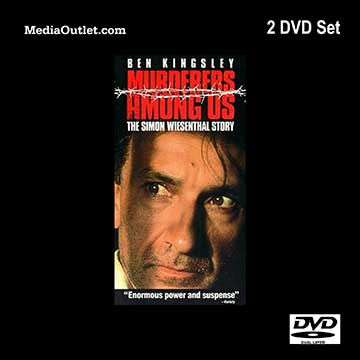
May 11, 1960: The Aftermath Of The
European Civil War: World War II: The Second European War (The
European Theater Of World War II): The Holocaust (Shoah):
Operation Eichmann (The Capture Of Adolf Eichmann): -- Four
Israeli Mossad agents led by Rafael "Rafi" Eitan capture
fugitive Nazi Adolf Eichmann near his home on Garibaldi Street in
San Fernando, Buenos Aires, an industrial community 20 kilometres
(12 mi) north of the centre of Buenos Aires, while he was living
under the alias of Ricardo Klement. Several survivors of the
Holocaust dedicated themselves to finding Eichmann and other
Nazis, and among them was Jewish Nazi hunter Simon Wiesenthal.
Wiesenthal learned from a letter shown to him in 1953 that
Eichmann had been seen in Buenos Aires, and he passed along that
information to the Israeli consulate in Vienna in 1954. Eichmann's
father died in 1960, and Wiesenthal made arrangements for private
detectives to surreptitiously photograph members of the family;
Eichmann's brother Otto was said to bear a strong family
resemblance and there were no current photos of the fugitive. He
provided these photographs to Mossad agents on February 18. Lothar
Hermann was also instrumental in exposing Eichmann's identity; he
was a half-Jewish German who had emigrated to Argentina in 1938.
His daughter Sylvia began dating a man named Klaus Eichmann in
1956 who boasted about his father's Nazi exploits, and Hermann
alerted Fritz Bauer, prosecutor-general of the state of Hesse in
West Germany. Hermann then sent his daughter on a fact-finding
mission; she was met at the door by Eichmann himself, who said
that he was Klaus's uncle. Klaus arrived not long after, however,
and addressed Eichmann as "Father". In 1957, Bauer
passed along the information in person to Mossad director Isser
Harel, who assigned operatives to undertake surveillance, but no
concrete evidence was initially found. Harel dispatched Shin Bet
chief interrogator Zvi Aharoni to Buenos Aires on March 1, 1960,
and he was able to confirm the identity of the fugitive after
several weeks of investigation. Argentina had a history of turning
down extradition requests for Nazi criminals, so rather than
filing a probably futile request for extradition, Israeli Prime
Minister David Ben-Gurion made the decision that Eichmann should
be captured and brought to Israel for trial. Harel arrived in May
1960 to oversee the capture. Mossad operative and future Israeli
politician Rafael "Rafi" Eitan was named leader of the
eight-man team, most of whom were Shin Bet agents. The agents
arrived in April and observed his routine for many days, noting
that he arrived home from work by bus at about the same time every
evening. They planned to seize him when he was walking beside an
open field from the bus stop to his house. The plan was almost
abandoned on the designated day when Eichmann was not on the bus
that he usually took home, but he got off another bus about half
an hour later. Mossad agent Peter Malkin engaged him, asking him
in Spanish if he had a moment. Eichmann was frightened and
attempted to leave, but two more Mossad men came to Malkin's aid.
The three wrestled Eichmann to the ground and, after a struggle,
moved him to a car where they hid him on the floor under a
blanket. Eichmann was taken to one of several Mossad safe houses
that had been set up by the team. He was held there for nine days,
during which time his identity was double-checked and confirmed.
During these days, Harel tried to locate Josef Mengele, the
notorious Nazi doctor from Auschwitz, as the Mossad had
information that he was also living in Buenos Aires. He was hoping
to bring Mengele back to Israel on the same flight. However,
Mengele had already left his last known residence in the city, and
Harel was unable to get any leads on where he had gone, so the
plans for his capture had to be abandoned. Eitan told Haaretz
newspaper in 2008 that they intentionally made the decision not to
pursue Mengele, reasoning that to do so might jeopardise Operation
Eichmann. Near midnight on May 20, Eichmann was sedated by an
Israeli doctor on the Mossad team and dressed as a flight
attendant. He was smuggled out of Argentina aboard the same El Al
Bristol Britannia aircraft that had carried Israel's delegation a
few days earlier to the official 150th anniversary celebration of
Argentina's independence from Spain. There was a tense delay at
the airport while the flight plan was approved, then the plane
took off for Israel, stopping in Dakar, Senegal to refuel. They
arrived in Israel on May 22, and Ben-Gurion announced Eichmann's
capture to the Knesset the following afternoon. In Argentina, the
news of the abduction was met with a violent wave of antisemitism
carried out by far-right elements, including the Tacuara
Nationalist Movement. Argentina requested an urgent meeting of the
United Nations Security Council in June 1960, after unsuccessful
negotiations with Israel, as they regarded the capture to be a
violation of their sovereign rights. In the ensuing debate,
Israeli representative (and later Prime Minister) Golda Meir
claimed that the abductors were not Israeli agents but private
individuals and so the incident was only an "isolated
violation of Argentine law". On June 23, the Council passed
Resolution 138 which agreed that Argentine sovereignty had been
violated and requested that Israel should make reparations. Israel
and Argentina issued a joint statement on August 3, after further
negotiations, admitting the violation of Argentinian sovereignty
but agreeing to end the dispute. The Israeli court ruled that the
circumstances of his capture had no bearing on the legality of his
trial. US Central Intelligence Agency (CIA) documents declassified
in 2006 show that the capture of Eichmann caused alarm at the CIA
and West German Bundesnachrichtendienst (BND). Both organisations
had known for at least two years that Eichmann was hiding in
Argentina, but they did not act because it did not serve their
interests in the Cold War to do so. Both were concerned about what
Eichmann might say in his testimony about West German national
security advisor Hans Globke, who had coauthored several
antisemitic Nazi laws, including the Nuremberg Laws. The documents
also revealed that both agencies had used some of Eichmann's
former Nazi colleagues to spy on European Communist countries.
Having been found guilty of war crimes before a special tribunal
of the Jerusalem District Court in 1961, Eichmann was hanged at a
prison in Ramla, Israel a few minutes past midnight on June 1,
1962. The execution was attended by a small group of officials,
four journalists and the Canadian clergyman William Lovell Hull,
who had been his spiritual counselor while in prison. His last
words were reported to be "Long live Germany. Long live
Argentina. Long live Austria. These are the three countries with
which I have been most connected and which I will not forget. I
greet my wife, my family and my friends. I am ready. We'll meet
again soon, as is the fate of all men. I die believing in God.
Rafi Eitan, who accompanied Eichmann to the hanging, claimed in
2014 to have heard him later mumble "I hope that all of you
will follow me", marking those as his actual last words.
Within hours Eichmann's body had been cremated, and his ashes
scattered in the Mediterranean Sea, outside Israeli territorial
waters, by an Israeli Navy patrol boat. On Sale @ 15% Off Discount
Till Midnight PT!
https://store.earthstation1.com/murderers-among-us-the-simon-wiesenthal-story-dvd-2-disc-se2.html
Today's
EarthStation1.com 15% Off Commemorative Memorial Title: Hoover Vs
The Kennedys The Second Civil War TV Series MP4 Download DVD
Today, May 11, 2026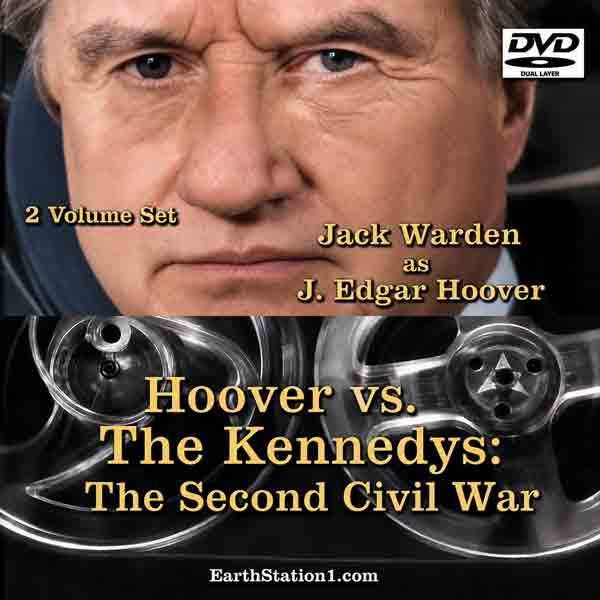
May 11, 1963: Civil Rights Movements: The
American Civil Rights Movement (1954-1968): Anti-Black Racism In
The United States: The Birmingham Campaign (The Birmingham
Movement, The Birmingham Confrontation): The Birmingham Riot Of
1963: -- Racist bombings in Birmingham, Alabama disrupt
nonviolence in the Birmingham campaign, provoking riots that
precipitated a crisis involving federal troops. The Birmingham
Riot Of 1963 was a civil disorder in Birmingham, Alabama, that was
provoked by bombings on the night of May 11, 1963. The bombings
targeted black leaders of the Birmingham campaign, a mass protest
for racial justice. The places bombed were the parsonage of Rev.
A. D. King, brother of Martin Luther King, Jr., and a motel owned
by A. G. Gaston, where King and others organizing the campaign had
stayed. Martin Luther King, Jr. was a leader of the Birmingham
civil rights campaign which had been conducted that spring, with
large, nonviolent demonstrations resulting in the mass arrest of
schoolchildren who were trying to take a walk to Birmingham City
Hall to talk to the mayor about segregation. Witnesses saw
Birmingham police place bombs at the parsonage, which was
partially destroyed. All the family escaped. It was believed that
the bombings were most likely planned and carried out by members
of the Ku Klux Klan (KKK). Since the 1950s, KKK members in
Birmingham had used bombings against civil rights leaders and
blacks who started to move into tradtionally white neighborhoods.
After the attacks, blacks in the area began to riot because of the
police involvement, and were repressed severely by the Birmingham
Police Department. The United States government intervened with
federal troops for the first time to control violence during a
civil rights related riot. It was also the first time the
government had used military troops independently of enforcing a
court injunction, an action was considered controversial by
Governor George Wallace and other Alabama whites. The bombings and
police response were a pivotal event that contributed to President
Kennedy's decision to propose civil rights legislation to achieve
relief of injustice. It was ultimately passed under President
Lyndon B. Johnson as the Civil Rights Act Of 1964. The Birmingham
Campaign, or Birmingham Movement, was a movement organized in
early 1963 by the Southern Christian Leadership Conference (SCLC)
to bring attention to the integration efforts of African Americans
in Birmingham, Alabama. Led by Martin Luther King Jr., James
Bevel, Fred Shuttlesworth and others, the campaign of nonviolent
direct action culminated in widely publicized confrontations
between young black students and white civic authorities, and
eventually led the municipal government to change the city's
discrimination laws. In the early 1960s, Birmingham was one of the
most racially divided cities in the United States, both as
enforced by law and culturally. Black citizens faced legal and
economic disparities, and violent retribution when they attempted
to draw attention to their problems. Martin Luther King Jr. called
it the most segregated city in the country. Protests in Birmingham
began with a boycott led by Shuttlesworth meant to pressure
business leaders to open employment to people of all races, and
end segregation in public facilities, restaurants, schools, and
stores. When local business and governmental leaders resisted the
boycott, SCLC agreed to assist. Organizer Wyatt Tee Walker joined
Birmingham activist Shuttlesworth and began what they called
Project C, a series of sit-ins and marches intended to provoke
mass arrests. When the campaign ran low on adult volunteers, James
Bevel, SCLC's Director of Direct Action, thought of the idea of
having students become the main demonstrators in the Birmingham
campaign. He then trained and directed high school, college, and
elementary school students in nonviolence, and asked them to
participate in the demonstrations by taking a peaceful walk fifty
at a time from the 16th Street Baptist Church to City Hall in
order to talk to the mayor about segregation. This resulted in
over a thousand arrests, and, as the jails and holding areas
filled with arrested students, the Birmingham Police Department,
led by Eugene "Bull" Connor, used high-pressure water
hoses and police attack dogs on the children and adult bystanders.
Not all of the bystanders were peaceful, despite the avowed
intentions of SCLC to hold a completely nonviolent walk, but the
students held to the nonviolent premise. King and the SCLC drew
both criticism and praise for allowing children to participate and
put themselves in harm's way. The Birmingham campaign was a model
of nonviolent direct action protest and, through the media, drew
the world's attention to racial segregation in the South. It
burnished King's reputation, ousted Connor from his job, forced
desegregation in Birmingham, and directly paved the way for the
Civil Rights Act Of 1964 which prohibited racial discrimination in
hiring practices and public services throughout the United States.
On Sale @ 15% Off Discount Till Midnight PT!
https://store.earthstation1.com/hoover-vs-the-kennedys-the-second-civil-war-tv-series-mp4-download-dv4.html
Today's
EarthStation1.com 15% Off Commemorative Memorial Title: Eyes On
The Prize II: America At The Racial Crossroads DVD MP4 USB
Today, May 11, 2026
May 11, 1967: Civil Rights Movements: The
American Civil Rights Movement (1954-1968): The Protests Of 1968:
Poverty: Poverty In The United States The Poor People's Campaign
(The Poor People's March On Washington): -- Nine caravans of poor
people arrive in Washington for first phase of Poor People's
Campaign; caravans had started out from different sections of
country on May 2, and picked up demonstrators along the way. The
Poor People's Campaign was a civil rights movement that sought to
gain economic justice for poor people in the United States. It was
organized by Martin Luther King Jr. and the Southern Christian
Leadership Conference (SCLC), and carried out under the leadership
of Ralph Abernathy in the wake of King's assassination in April
1968. The campaign demanded economic and human rights for poor
Americans of diverse backgrounds. After presenting an organized
set of demands to Congress and executive agencies, participants
set up a 3,000-person protest camp on the Washington Mall, where
they stayed for six weeks in the spring of 1968. The Poor People's
Campaign was motivated by a desire for economic justice: the idea
that all people should have what they need to live. King and the
SCLC shifted their focus to these issues after observing that
gains in civil rights had not improved the material conditions of
life for many African Americans. The Poor People's Campaign was a
multiracial effort-including African Americans, European
Americans, Asian Americans, Hispanic Americans, and Native
Americans-aimed at alleviating poverty regardless of race.
According to political historians such as Barbara Cruikshank, "the
poor" did not particularly conceive of themselves as a
unified group until President Lyndon Johnson's War on Poverty
(declared in 1964) identified them as such. Figures from the 1960
census, Bureau of Labor Statistics, U.S. Commerce Department, and
the Federal Reserve estimated anywhere from 40 to 60 million
Americans-or 22 to 33 percent-lived below the poverty line. At the
same time, the nature of poverty itself was changing as America's
population increasingly lived in cities, not farms (and could not
grow its own food). By 1968, The War On Poverty seemed like a
failure, neglected by a Johnson administration (and Congress) that
wanted to focus on the Vietnam War and increasingly saw
anti-poverty programs as primarily helping African Americans.[5]
The Poor People's Campaign sought to address poverty through
income and housing. The campaign would help the poor by
dramatizing their needs, uniting all races under the commonality
of hardship and presenting a plan to start to a solution.[6] Under
the "economic bill of rights," the Poor People's
Campaign asked for the federal government to prioritize helping
the poor with a 30B USD anti-poverty package that included, among
other demands, a commitment to full employment, a guaranteed
annual income measure and more low-income housing. The Poor
People's Campaign was part of the second phase of the civil rights
movement. King said, "We believe the highest patriotism
demands the ending of the war and the opening of a bloodless war
to final victory over racism and poverty". King wanted to
bring poor people to Washington, D.C., forcing politicians to see
them and think about their needs: "We ought to come in mule
carts, in old trucks, any kind of transportation people can get
their hands on. People ought to come to Washington, sit down if
necessary in the middle of the street and say, 'We are here; we
are poor; we don't have any money; you have made us this way...
and we've come to stay until you do something about it.'" On
Sale @ 15% Off Discount Till Midnight PT!
https://store.earthstation1.com/eyes-on-the-prize-ii-dvd-set-4-discs-complete-2nd-seri42.html
Today's
EarthStation1.com #OnThisDay Commemorative Memorial Title: The Old
Time Radio Comedy MegaSet MP3 Collection DVD, Download, USB
Today, May 11, 2026 May 11, 2025: Second Sunday In May:
Mother's Day (United States): -- Mother's Day, or Mothers' Day, is
a celebration honoring the mother of the family or individual, as
well as motherhood, maternal bonds, and the influence of mothers
in society. It is celebrated on different days in many parts of
the world, most commonly in the months of March or May. It
complements similar celebrations, honoring family members, such as
Father's Day, Siblings Day, and Grandparents' Day. While some
countries have a multi-century history of a day to celebrate
mothers, the modern American version of the holiday began in the
United States in the early 20th century at the initiative of Anna
Jarvis, who organized the first Mother's Day service of worship
and celebration at Andrews Methodist Episcopal Church in Grafton,
West Virginia, which serves as the International Mother's Day
Shrine today. It is not directly related to the many traditional
celebrations of mothers and motherhood that have existed
throughout the world over thousands of years, such as the Greek
cult to Cybele, the mother deity Rhea, the Roman festival of
Hilaria, or the other Christian ecclesiastical Mothering Sunday
celebration (associated with the image of Mother Church). However,
in some countries, Mother's Day is still synonymous with these
older traditions. The American version of Mother's Day has been
criticized for having become too commercialized. Jarvis herself,
who began the celebration as a liturgical observance, regretted
this commercialism and expressed that this was never her
intention. In response, Constance Adelaide Smith successfully
advocated for Mothering Sunday as a commemoration of a broader
definition of motherhood in many other parts of the
English-speaking world.
https://store.earthstation1.com/old-time-radio-comedy-mp3-dvd-megaset-2-dis32.html
Today's
EarthStation1.com #OnThisDay Commemorative Memorial Title: Darrow
(1991) Kevin Spacey TV Docudrama DVD, Video Download, USB Drive
Today, May 11, 2026May 11, 1894: Labor Union Disputes (Trade
Union Disputes): Strikes (Strike Actions, Labor Strikes, Labour
Strikes): The Pullman Strike: -- The Pullman Strike against the
Pullman Car Company begins in the company town of Pullman on the
South Side of Chicago, Illinois when nearly 4,000 factory
employees of the Pullman Palace Car Company go on a wildcat strike
in response to recent reductions in wages. By strike's end, a
total of 30 workers were killed in riots, and sabotage caused 80M
USD in damages. The Pullman Strike lasted from May 11 to July 20,
1894, and was a turning point for US labor law. It pitted the
American Railway Union (ARU) against the Pullman Company, the main
railroads, and the federal government of the United States under
President Grover Cleveland. The strike and boycott shut down much
of the nation's freight and passenger traffic west of Detroit,
Michigan. Most of the factory workers who built Pullman cars lived
of Pullman, Chicago. The industrialist George Pullman had designed
it ostensibly as a model community. Pullman had a diverse work
force. He wanted to hire African Americans for certain jobs at the
company. Pullman used ads and other campaigns to help bring
workers into his company. When his company laid off workers and
lowered wages, it did not reduce rents, and the workers called for
a strike. Among the reasons for the strike were the absence of
democracy within the town of Pullman and its politics, the rigid
paternalistic control of the workers by the company, excessive
water and gas rates, and a refusal by the company to allow workers
to buy and own houses. They had not yet formed a union. Founded in
1893 by Eugene V. Debs, the ARU was an organization of unskilled
railroad workers. Debs brought in ARU organizers to Pullman and
signed up many of the disgruntled factory workers. When the
Pullman Company refused recognition of the ARU or any
negotiations, ARU called a strike against the factory, but it
showed no sign of success. To win the strike, Debs decided to stop
the movement of Pullman cars on railroads. The over-the-rail
Pullman employees (such as conductors and porters) did not go on
strike. Debs and the ARU called a massive boycott against all
trains that carried a Pullman car. It affected most rail lines
west of Detroit and at its peak involved some 250,000 workers in
27 states. The railroad brotherhoods and the American Federation
Of Labor (AFL) opposed the boycott, and the General Managers'
Association of the railroads coordinated the opposition. The
federal government obtained an injunction against the union, Debs,
and other boycott leaders, ordering them to stop interfering with
trains that carried mail cars. After the strikers refused,
President Grover Cleveland ordered in the Army to stop the
strikers from obstructing the trains. Violence broke out in many
cities, and the strike collapsed. Debs was arrested on federal
charges, including conspiracy to obstruct the mail as well as
disobeying a federal injunction directed to him by the U.S.
Supreme Court to stop the obstruction of railways and to dissolve
the boycott. He was defended by Clarence Darrow, as well as Lyman
Trumbull. At the conspiracy trial, Darrow argued that it was the
railways, not Debs and his union, that met in secret and conspired
against their opponents. Sensing that Debs would be acquitted, the
prosecution dropped the charge when a juror took ill. Although
Darrow also represented Debs at the U.S. Supreme Court for
violating the federal injunction, Debs was sentenced to six months
in prison. The ARU thereafter dissolved.
https://store.earthstation1.com/darrow-1991-dvd-kevin-spacey-tv-m1991.html
Today's
EarthStation1.com #OnThisDay Commemorative Memorial Title: Radio
Broadcasting History Films DVD, Video Download, USB Flash Drive
Today, May 11, 2026May 11, 1960: #DOTD: #RIP! John D.
Rockefeller Jr., American businessman, financier and
philanthropist (b. January 29, 1874) #dies of pneumonia at the age
of 86 in Tucson, Arizona. He is interred in the family cemetery in
Tarrytown, New York. He was born John Davison Rockefeller Jr. in
Cleveland, Ohio, the fifth and last child, and only son, of
Standard Oil co-founder John Davison Rockefeller Sr. and
schoolteacher Laura Celestia "Cettie" Spelman. John D.
Rockefeller was the only son of Standard Oil co-founder John D.
Rockefeller. He was involved in the development of the vast office
complex in Midtown Manhattan known as Rockefeller Center, making
him one of the largest real estate holders in the city. Towards
the end of his life, he was famous for his philanthropy, donating
over 500M USD to a wide variety of different causes, including
educational establishments and museums. Among his projects was the
reconstruction of Colonial Williamsburg in Virginia. He was widely
blamed for having orchestrated the Ludlow Massacre and other
offenses during the Colorado Coalfield War. Rockefeller was the
father of six children: Abby, John III, Nelson, Laurance,
Winthrop, and David.
https://store.earthstation1.com/radio-broadcasting-history-films-2-dvd-se2.html
Today's
EarthStation1.com #OnThisDay Commemorative Memorial Title: James
Jesus Angleton & The Monster Plot MP4 Video Download DVD
Today, May 11, 2026May 11, 1987: #DOTD: James Jesus
Angleton, American intelligence operative who served as chief of
counterintelligence for the Central Intelligence Agency from 1954
to 1975 (b. December 9, 1917) $dies of cancer in Washington, D.C.,
aged 69. He is buried at Morris Hill Cemetery in Boise, Idaho.
James Jesus Angleton was born in Boise, Idaho, the eldest of four
children of James Hugh Angleton (1888-1973) and Carmen Mercedes
Moreno (1898-1985). His parents met in Nogales, Arizona, while his
father was a U.S. Army cavalry officer serving under General John
Pershing. Carmen Moreno was born in Mexico but was already a
naturalized American citizen before she married James H. Angleton
in December 1916. According to Director of Central Intelligence
Richard Helms, Angleton was "recognized as the dominant
counterintelligence figure in the non-communist world".
Angleton served in the Office of Strategic Services, a wartime
predecessor to the CIA, in Italy and London during World War II.
After the war, he returned to Washington, D.C. to become one of
the founding officers of the CIA. He was initially responsible for
the collection of foreign intelligence and liaison with
counterpart organizations in allied countries. In 1954, Allen
Dulles promoted Angleton to chief of the Counterintelligence
Staff. As chief, Angleton was significantly involved in the
defection of Soviet KGB agents Anatoliy Golitsyn and Yuri Nosenko.
Through Golitsyn, Angleton became convinced of "The Monster
Plot" - that the CIA harbored a high-ranking Soviet mole -
and engaged in an intensive search that did great damage to the
careers of many innocent agents and, according to CIA Director
William Colby, virtually brought the CIA's actual
counterintelligence service results to a halt for nearly a decade.
This highly destructive witch hunt remains a subject of intense
historical debate.
https://store.earthstation1.com/james-jesus-angleton-and-the-monster-plot-mp4-video-download-dvd.html
Today's
EarthStation1.com #OnThisDay Commemorative Memorial Title:
Presenting America's New Comedy Sensations Stiller & Meara CD
MP3 USB
Today, May 11, 2026May 11, 2020: #DOTD: #RIP: Jerry Stiller,
American actor, comedian and producer (b. June 8, 1927) #dies of
natural causes at his home on the Upper West Side of Manhattan at
the age of 92. He is buried at Nantucket Jewish Cemetery in
Nantucket, Massachusetts. Gerald Isaac Stiller was born Gerald
Isaac Stiller at Unity Hospital in Brooklyn, New York City into a
Jewish family. He spent many years in the comedy team Stiller and
Meara with his wife, Anne Meara. He later played Frank Costanza on
the NBC sitcom Seinfeld and Arthur Spooner on the CBS comedy
series The King of Queens. Stiller and Meara are the parents of
actor Ben Stiller, with whom Stiller co-starred in the films
Zoolander, Heavyweights, Hot Pursuit, The Heartbreak Kid and
Zoolander 2. Stiller is known for his angry, yelling acting style.
https://store.earthstation1.com/presenting-america39s-new-comedy-sensations-stiller-and-meara-39.html
Today's
EarthStation1.com #OnThisDay Commemorative Memorial Title:
Complete Classic TV Kid Shows Series MegaSet DVD, MP4 Download,
USB
Today, May 11, 2026May 11, 1911: #BOTD: #HBD! Doodles
Weaver, American character actor, comedian, and musician (d.
January 17, 1983) is #born Winstead Sheffield Glenndenning Dixon
Weaver in Los Angeles, Weaver was one of four children born to
Sylvester Laflin Weaver, a wealthy roofing contractor, and Annabel
(nee Dixon) Weaver. His older brother was Pat Weaver who served as
the President of NBC in the 1950s, and Doodles Weaver's niece is
actress Sigourney Weaver. Weaver's mother gave him the nickname
"Doodlebug" as a child because of his freckles and big
ears. Weaver began his career in radio. In the late 1930s, he
performed on Rudy Vallee's radio programs and Kraft Music Hall. He
later joined Spike Jones' City Slickers. In 1957, Weaver hosted
his own NBC variety show The Doodles Weaver Show. In addition to
his radio work, he also recorded a number of comedy records,
appeared in films and guest starred on numerous television series
from the 1950s through the 1970s. Weaver made his last onscreen
appearance in 1981. Doodles Weaver died aged 71 in Burbank, Los
Angeles County, California when, despondent and overcome with poor
health, he fatally shot himself. He is buried at Avalon Cemetery
in Avalon, Los Angeles County, California.
https://store.earthstation1.com/4-disc-classic-tv-kid-shows-complete-dvd-se4.html
Today's
EarthStation1.com #OnThisDay Commemorative Memorial Title: Ulysses
S. Grant & The Battle Of The Wilderness DVD MP4 USB Drive
Today, May 11, 2026May 11, 1864: The American Civil War (The
Civil War, The War Between The States): The Eastern Theater Of The
American Civil War: The Overland Campaign (Grant's Overland
Campaign, The Wilderness Campaign): The Battle Of Yellow Tavern:
-- The Battle Of Yellow Tavern is fought on May 11, 1864, as part
of the Overland Campaign of the American Civil War. Union cavalry
under Maj. Gen. Philip Sheridan was detached from Grant's Army Of
The Potomac to conduct a raid on Richmond, Virginia, and
challenged Confederate cavalry commander Maj. Gen. J.E.B. Stuart.
The Confederates were outnumbered, and Stuart was mortally
wounded. However, Sheridan's 'sideshow' did not achieve any of its
other objectives, and had meanwhile deprived Grant's army of key
cavalry functions at Spotsylvania. Maj. Gen. J. E. B. Stuart,
American and Confederate general (b. February 6, 1833) died the
following day, May 12, 1864, at 7:38 p.m. of a .44-caliber gunshot
wound received during the battle, fired by retreating 5th Michigan
Cavalry private John A. Huff, who shot Stuart with his revolver
from a distance of 10-30 yards, striking Stuart in the left side,
slicing through his stomach and exiting his back, one inch to the
right of his spine. He was 31 years old. He suffered great pain as
an ambulance took him to Richmond to await his wife's arrival at
the home of Dr. Charles Brewer, his brother-in-law. Stuart ordered
his sword and spurs be given to his son. Confederate President
Jefferson Davis came to his side, took General Stuart's hand, and
asked, "General, how do you feel?" Stuart answered
"Easy, but willing to die, if God and my country think I have
fulfilled my destiny and done my duty." His last whispered
words were: "I am resigned; God's will be done." He died
the following day, before Flora Stuart reached his side. Stuart
was buried in Richmond's Hollywood Cemetery. Upon learning of
Stuart's death, General Lee is reported to have said that he could
hardly keep from weeping at the mere mention of Stuart's name and
that Stuart had never given him a bad piece of information.
Stuart's wife Flora wore the black of mourning for the remainder
of her life, and never remarried. John Huff, the private who had
fatally wounded Stuart, was killed in action just a few weeks
later at the Battle of Haw's Shop.
https://store.earthstation1.com/ulysses-s-grant-amp-the-battle-of-the-wilderness-dvd-mp4-usb-driv4.html
Today's
EarthStation1.com #OnThisDay Commemorative Memorial Title:
Muhammad Ali Documentaries And Entire Fights DVD, Download, USB
Drive
Today, May 11, 2026May 11, 2006: #DOTD: #RIP: Floyd
Patterson, African American professional boxer and actor (b.
January 4, 1935) #dies of prostate cancer at his home in New
Paltz, New York at the age of 71. His body was buried at New Paltz
Rural Cemetery in New Paltz, Ulster County, New York. Floyd
Patterson was born into a poor family in Waco, North Carolina, one
of eleven children. Floyd Patterson twice reigned as the world
heavyweight champion between 1956 and 1962 and competed from 1952
to 1972. At the age of 21, he became the youngest boxer in history
to win the title of Heavyweight Champion Of The World, and was
also the first heavyweight to regain the title after losing it. As
an amateur, he won a gold medal in the middleweight division at
the 1952 Summer Olympics. In 1956 and 1960, Patterson was voted
Fighter of the Year by The Ring magazine and the Boxing Writers
Association of America. He was inducted into the International
Boxing Hall of Fame in 1991.
https://store.earthstation1.com/muhammad-ali--dvd-2-discs-documentaries-and-entire-fight2.html
Today's
EarthStation1.com #OnThisDay Commemorative Memorial Title:
Moscow's Man: Kim Philby UK Double Agent For USSR DVD, Download,
USB
Today, May 11, 2026May 11, 1988: #DOTD. Kim Philby, British
traitor, high-ranking member of British intelligence who worked as
a double agent before defecting to the Soviet Union in 1963,
serving as both an NKVD and KGB operative, member of the spy ring
now known as the Cambridge Five (b. January 1, 1912) #dies of
heart failure in Moscow. He was given a hero's funeral, and
posthumously awarded numerous medals by the Soviets: The Order Of
Lenin, The Order Of The Red Banner, The Order Of Friendship Of
Peoples, The Order Of The Great Patriotic War, The Lenin Medal and
The Jubilee Medal "Forty Years of Victory in the Great
Patriotic War 1941-1945". He is buried at Kuntsevskoye
Cemetery in Moscow, Russia. Kim Philby was born Harold Adrian
Russell Philby in Ambala, Punjab, British India. He was nicknamed
"Kim" after the Irish boy Kimball O'Hara, the British
spy in Rudyard Kipling's novel Kim, whose story unfolds against
the backdrop of the Great Game, the political conflict between the
19th-century British and Russian Empires over influence in Asia,
primarily in Afghanistan, Persia, and later Tibet, a novel that
popularized the phrase and idea of the Great Game. In 1963, Philby
was revealed to be a member of the Cambridge Five British spy
ring, the other members of which were Donald Maclean, Guy Burgess,
Anthony Blunt and, possibly, John Cairncross. Of the five, Philby
is believed to have been most successful in providing secret
information to the Soviet Union. His activities were moderated
only by Joseph Stalin' fears that he was a triple agent providing
Soviet intelligence to British authorities. Philby was an Officer
of the Order of the British Empire (OBE) from 1946 to 1965, and he
was awarded the Order of Lenin in 1965. J. Edgar Hoover long
suspected Philby' loyalties for decades, but his advice was not
acted upon. On the evening of 23 January 1963, Philby vanished
from Beirut, failing to meet his wife for a dinner party at the
home of Glencairn Balfour Paul, First Secretary at the British
Embassy. The Dolmatova, a Soviet freighter bound for Odessa, had
left Beirut that morning so abruptly that cargo was left scattered
over the docks; Philby claimed that he left Beirut on board this
ship. However, others maintain that he escaped through Syria,
overland to Soviet Armenia and thence to Russia. It was not until
1 July 1963, over five months later, that Philby' flight to Moscow
was officially confirmed. On 30 July Soviet officials announced
that they had granted him political asylum in the USSR, along with
Soviet citizenship. When the news broke, MI6 came under criticism
for failing to anticipate and block Philby' defection, though
Elliott was to claim he could not have prevented Philby' flight.
Journalist Ben Macintyre, author of several works on espionage,
wrote in his 2014 book on Philby that MI6 might have left open the
opportunity for Philby to flee to Moscow to avoid an embarrassing
public trial. Philby himself thought this might have been the
case, according to Macintyre. When FBI Director J. Edgar Hoover
was informed that one of MI6's top men was a spy for the Russians,
he said, "Tell 'em Jesus Christ only had twelve, and one of
them was a double [agent].".
https://store.earthstation1.com/moscow39s-man-kim-philby-dvd-uk-double-agent-for-us39.html
Today's
EarthStation1.com #OnThisDay Commemorative Memorial Title: Crime
Inc.: The True Story Of The Mafia TV Series DVD, MP4, USB Stick
Today, May 11, 2026May 11, 2002: #DOTD: Joseph Bonanno,
sometimes referred to as Joe Bananas, Italian-American mob boss of
the Bonanno crime family (b. January 18, 1905) #dies of heart
failure at the age of 97 in Tucson, Arizona. He is buried at Holy
Hope Cemetery & Mausoleum in Tucson. Joseph Bonanno was born
Giuseppe Carlo Bonanno in Castellammare del Golfo, Sicily, to
Salvatore Bonanno and Catherine Bonventre. Joseph's uncles,
Giuseppe Bonanno and his older brother and advisor, Stefano, led a
mafia clan in Castellammare del Golfo. At the age of three,
Bonanno immigrated to New York City with his family, for about 10
years before he moved back to Italy. He later slipped back into
the United States in 1924, by stowing away on a Cuban fishing boat
bound for Tampa, Florida. After the Castellammarese War, Salvatore
Maranzano was murdered in 1931, and Bonanno took control of most
of the crime family, and at age 26, Bonanno became one of the
youngest-ever bosses of a crime family. In 1963, Bonanno made
plans with Joseph Magliocco to assassinate several rivals on the
Mafia Commission. When Magliocco gave the contract to one of his
top hit men, Joseph Colombo, he revealed the plot to its targets.
The Commission spared Magliocco's life but forced him into
retirement, while Bonanno fled to Canada. In 1964, he briefly
returned to New York before disappearing until 1966. This ensued
the "Banana War" that lasted until 1968, when Bonanno
retired to Arizona. Later in life, he became a writer, publishing
the book A Man of Honor: The Autobiography of Joseph Bonanno in
1983.
https://store.earthstation1.com/crime-inc-the-true-story-of-the-mafia-dvd-set-2-disc2.html
Today's
EarthStation1.com #OnThisDay Commemorative Memorial Title: Hearts
& Minds 1974 Vietnam War Documentary Feature Film DVD, MP4,
USB
Today, May 11, 2026May 11, 1973: The Aftermath Of World War
II: The Cold War: The Cold War In Asia: The Indochina Wars: The
Vietnam War (The Second Indochina War, The Vietnam Conflict, The
Resistance War Against America): The United States In The Vietnam
War: The Pentagon Papers (The History Of U.S. Decision-Making In
Vietnam, 1945-1968): -- Citing government misconduct, Daniel
Ellsberg's charges for his involvement in releasing the Pentagon
Papers to The New York Times are dismissed. The Pentagon Papers,
officially titled Report Of The Office Of The Secretary Of Defense
Vietnam Task Force, is a United States Department of Defense
history of the United States' political and military involvement
in Vietnam from 1945 to 1967. The papers were released by Daniel
Ellsberg, who had worked on the study; they were first brought to
the attention of the public on the front page of The New York
Times in 1971. A 1996 article in The New York Times said that the
Pentagon Papers had demonstrated, among other things, that the
Johnson Administration "systematically lied, not only to the
public but also to Congress". More specifically, the papers
revealed that the U.S. had secretly enlarged the scope of its
actions in the Vietnam War with the bombings of nearby Cambodia
and Laos, coastal raids on North Vietnam, and Marine Corps
attacks, none of which were reported in the mainstream media. For
his disclosure of the Pentagon Papers, Ellsberg was initially
charged with conspiracy, espionage, and theft of government
property, but the charges were later dismissed after prosecutors
investigating the Watergate scandal discovered that the staff
members in the Nixon White House had ordered the so-called White
House Plumbers to engage in unlawful efforts to discredit
Ellsberg. In June 2011, the entirety of the Pentagon Papers was
declassified and publicly released.
https://store.earthstation1.com/hearts-and-minds-dvd-1974-vietnam-war-documentary-m1974.html
Today's
EarthStation1.com #OnThisDay Commemorative Memorial Title: A Duke
Named Ellington TV Series Duke Ellington DVD Download USB Drive
Today, May 11, 2026May 11, 1970: #DOTD: #RIP: Johnny Hodges,
African American saxophonist and clarinet player best known for
solo work with Duke Ellington's big band, where he played lead
alto in the saxophone section for many years (b. July 25, 1907)
#dies of a heart attack suffered during a visit to the office of a
dental surgeon in New York City, aged 62. His last recordings are
featured on the New Orleans Suite, which was only half-finished
when he died. The loss of Hodges's sound prompted Ellington, upon
learning of the musician's death from a heart attack, to lament to
JET magazine: "The band will never sound the same without
Johnny." In Ellington's eulogy of Hodges, he said: "Never
the world's most highly animated showman or greatest stage
personality, but a tone so beautiful it sometimes brought tears to
the eyes -- this was Johnny Hodges. This *is* Johnny Hodges."
He is buried in Flushing Cemetery in Flushing, Queens, New York
City. Johnny Hodges was born Cornelius Hodges in the Cambridgeport
neighborhood of Cambridge, Massachusetts to John H. Hodges and
Katie Swan Hodges, both originally from Virginia. Johnny Hodges
was also featured on soprano saxophone, but refused to play
soprano after 1946. He is considered one of the definitive alto
saxophone players of the big band era (along with Benny Carter).
After beginning his career as a teenager in Boston, Hodges began
to travel to New York and played with Lloyd Scott, Sidney Bechet,
Luckey Roberts and Chick Webb. When Ellington wanted to expand his
band in 1928, Ellington's clarinet player Barney Bigard
recommended Hodges. His playing became one of the identifying
voices of the Ellington orchestra. From 1951 to 1955, Hodges left
the Duke to lead his own band, but returned shortly before
Ellington's triumphant return to prominence - the orchestra's
performance at the 1956 Newport Jazz Festival. Hodges's last
performances were at the Imperial Room in Toronto, less than a
week before his death.
https://store.earthstation1.com/a-duke-named-ellington-dvd-complete-2-part-tv-serie2.html
Today's
EarthStation1.com #OnThisDay Commemorative Memorial Title: Jimi
Plays Monterey Jimi Hendrix DVD, Video Download, USB Flash Drive
Today, May 11, 2026May 11, 2003: #DOTD: #RIP: Noel Redding,
English rock musician, best known as the bass player for the Jimi
Hendrix Experience and guitarist/singer for Fat Mattress (b.
December 25, 1945) #dies at age 57 in his home in Clonakilty,
Ireland, three weeks after the death of his mother. A postmortem
was carried out on May 13 at Cork University Hospital in Wilton,
Cork that concluded Redding had died from "shock haemorrhage
due to oesophageal varices in reaction to cirrhosis of the liver".
His remains were cremated; the final disposition of his ashes are
not publicly known. Noel Redding was born David Noel Redding at
the Royal Victoria Hospital in Folkestone, Kent on Christmas Day,
hence the name "Noel". Following his departure from the
Experience in 1969 and the dissolution of Fat Mattress in 1970,
Redding formed the short-lived group Road in the United States,
which released the self-titled album Road before he re-located to
Clonakilty, Ireland, in 1972. There he formed the Noel Redding
Band with former Thin Lizzy guitarist Eric Bell, with whom he
released two albums. Although by the 1980s Redding had largely
removed himself from the music business, he would later perform
around his new hometown with wife Carol Appleby. He was inducted
into the Rock and Roll Hall of Fame in 1992 as a member of the
Jimi Hendrix Experience.
https://store.earthstation1.com/jimi-plays-monterey-dvd-complete-monterey-pop-performance.html
Today's
EarthStation1.com #OnThisDay Commemorative Memorial Title: Bob
Marley And The Wailers (1986) Documentary MP4 Video Download DVD
Today, May 11, 2026May 11, 1981: #DOTD: #RIP: Bob Marley,
African Jamaican singer-songwriter and guitarist who became an
international musical and cultural icon (b. February 6, 1945)
#dies in Miami, Florida at the age of 36 due to the spread of
melanoma to his lungs and brain. His final words to his son Ziggy
were "Money can't buy life". He is buried at The Bob
Marley Mausoleum in Nine Mile, Jamaica. Born Robert Nesta Marley
at the farm of his maternal grandfather in Nine Mile, Saint Ann
Parish, Jamaica, he blended reggae, ska and rocksteady in his
compositions. Starting out in 1963 with the group the Wailers, he
forged a distinctive songwriting and vocal style that would later
resonate with audiences worldwide. The Wailers would go on to
release some of the earliest reggae records with producer Lee
"Scratch" Perry. After the Wailers disbanded in 1974,
Marley pursued a solo career upon his relocation to England that
culminated in the release of the album Exodus in 1977, which
established his worldwide reputation and elevated his status as
one of the world's best-selling artists of all time, with sales of
more than 75 million records. Exodus stayed on the British album
charts for 56 consecutive weeks. It included four UK hit singles:
"Exodus", "Waiting in Vain", "Jamming",
and "One Love". In 1978, he released the album Kaya,
which included the hit singles "Is This Love" and
"Satisfy My Soul". The greatest hits album, Legend, was
released in 1984, three years after Marley died. It subsequently
became the best-selling reggae album of all time. Diagnosed with
acral lentiginous melanoma in 1977, Marley died on 11 May 1981 in
Miami at age 36. He was a committed Rastafari who infused his
music with a sense of spirituality. He is credited with
popularising reggae music around the world and served as a symbol
of Jamaican culture and identity. Marley has also evolved into a
global symbol and inspired numerous items of merchandise.
https://store.earthstation1.com/bob-marley-and-the-wailers-dvd-1986-documen1986.html